Rules, Regulations & Remarkably Bad Ideas
How Medieval Villages Tried to Stay Orderly… and Mostly Failed
If you imagine medieval villagers living wild, rule-free lives… you’d be wrong.
They actually lived under an astonishing amount of rules, fines, customs, fees, punishments, expectations, and strongly-worded “thou shalt nots.”
In theory, the rules existed to keep order. In practice, they existed to create:
- Petty disputes
- Complicated court sessions
- People pretending not to see things, and a spectacular number of fines
Welcome to Rules & Ridiculousness.
The Manorial Court Where Problems Went to Be Officially Acknowledged (Not Solved)
Every medieval village had its manorial court — the place where villagers took their problems, grudges, and questionable behaviour.
It handled:
- Boundary disputes
- Livestock trouble (so much livestock trouble)
- Unpaid rents
- Broken village rules
- “He insulted my entire family loudly in public” situations
The court wasn’t really about justice in the modern sense. It was about keeping order, protecting income, and reminding everyone who was in charge.
It also doubled as village entertainment. People came. People watched. People talked.
Half legal proceeding. Half social event. 100% gossip opportunity.
Everything Had a Fine
Medieval villages didn’t really “warn” people.
They fined them.
Didn’t maintain your hedges? Fine. Turned up late for labour service? Fine. Used the wrong oven? Fine. Borrowed something and “forgot” to return it? Fine.
Just generally existed inconveniently? Quite possibly… fine. You could be fined for:
- Laziness
- Rudeness
- Forgetfulness
- Stubbornness
- Bad agricultural decision-making
The village wasn’t lawless: It was deeply regulated — just inconsistently enforced and frequently chaotic.
Livestock: The True Criminals of the Middle Ages
If medieval records prove anything, it’s this: animals caused chaos constantly.
Stray pigs eating crops. Cows trampling fields. Sheep visiting places they absolutely should not be. Geese committing general acts of menace.
If an animal misbehaved, its owner paid.
If things were really out of hand, the creature was locked in the pinfold until its embarrassed owner came to collect it… publicly.
Imagine: “Yes, that’s my pig. Yes, it escaped again. Yes, I know everyone saw.”
The shame. The fees. The neighbourhood commentary.
Delicious.
Rules That Sound Sensible… Until Humans Get Involved
Many medieval rules started reasonably.
Then villagers interacted with them.
Curfews. Attendance requirements. Obligations to repair bridges, fences, hedges and paths. Expectations about behaviour and duty.
In theory: structure.
In reality:
- Convenient forgetfulness
- Arguing
- I was absolutely going to do it, I just didn’t” -“That’s not how we do it here actually”
- “My neighbour does worse!”
And so… back to court we go.
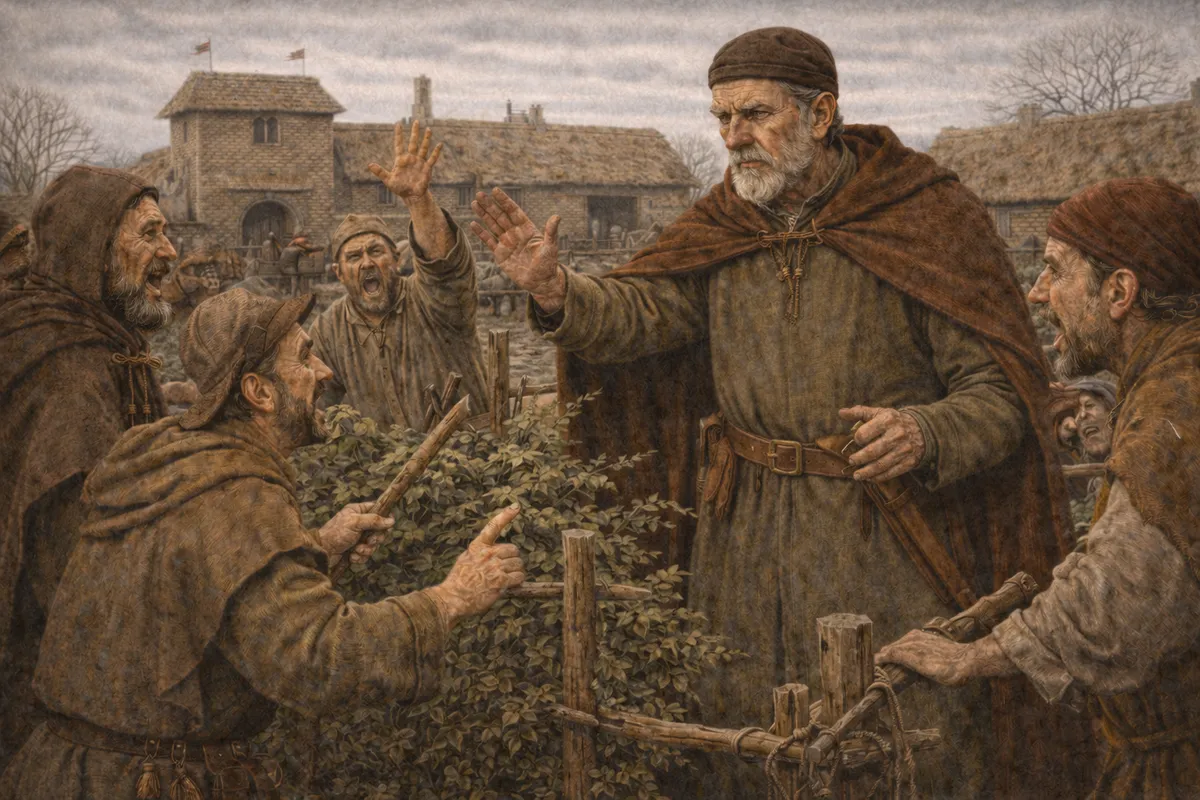
The Magic Word: “Custom”
So many rules depended on custom — “the way things have always been done.”
Unfortunately, people have VERY strong opinions about what has “always” been done.
Especially when money, labour or pride is involved.
“You owe three days’ labour.” “I’ve always only owed one.” “No you haven’t.” “Yes I have. Ask literally anyone.” “The steward says otherwise.”
And now: We have tension. We have paperwork. We have emotions and and we VERY much have drama.
In Summary
Medieval villagers didn’t live in chaos.
They lived in structured chaos.
A world of:
Fines. Rules. Expectations. Arguments. Paperwork. And endless human complication
There were systems. They just only half-worked.
Because humans are humans — now, and in 1309 — and wherever rules exist…
Ridiculousness follows.